Pakistan to Host Historic Iran-US Peace Deal Signing in Geneva on June 19, PM Shehbaz
PM Praises Army Chief, Allies and Global Leaders After Iran-US Deal
By Web Desk • Jun 16, 2026
Pakistan Emerges as Key Mediator in Iran-US Peace Breakthrough
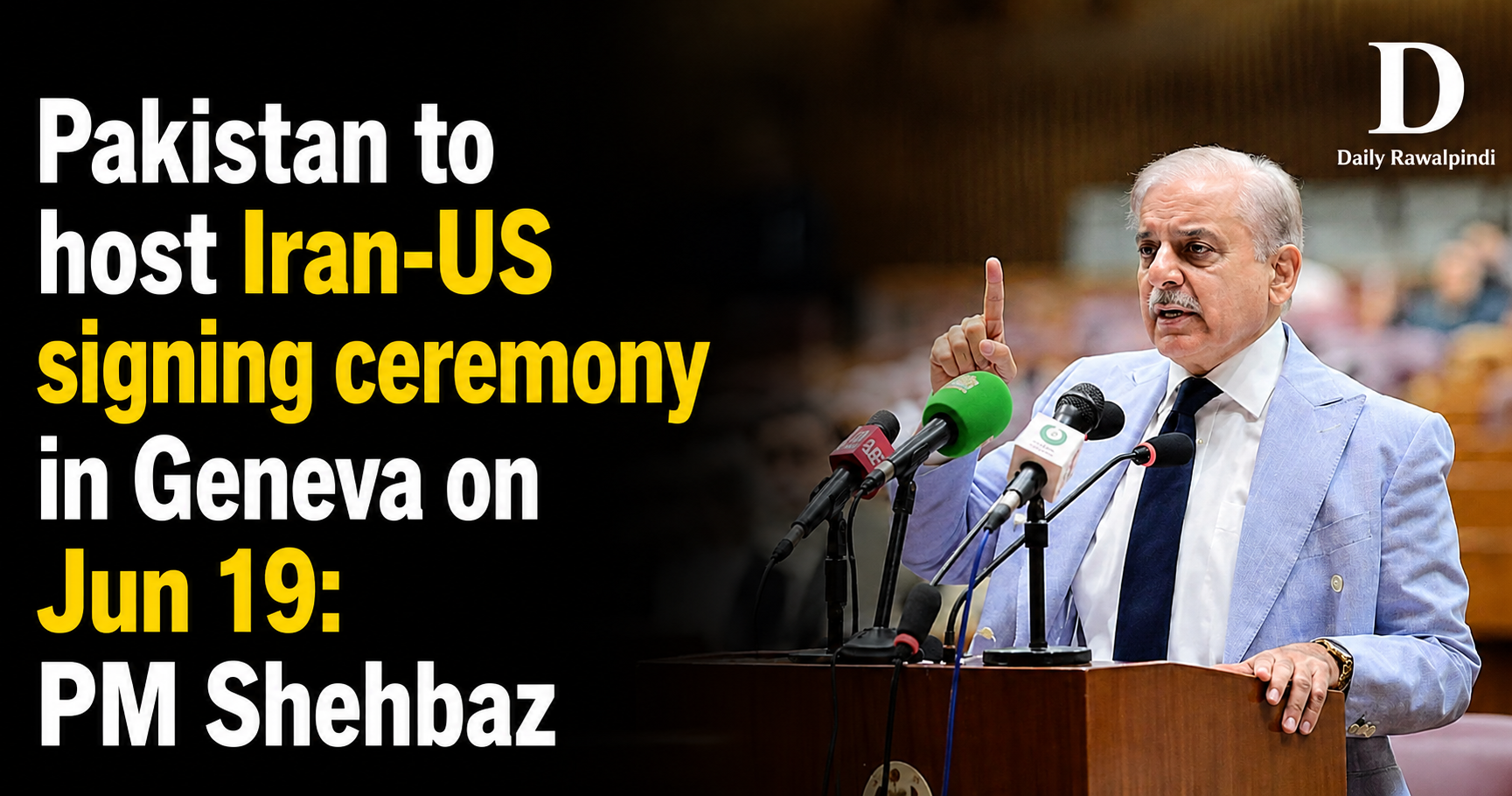
ISLAMABAD: Prime Minister Shehbaz Sharif on Monday announced that Pakistan will host the formal signing ceremony of the Iran-US peace agreement in Geneva, Switzerland, on June 19, describing the development as a historic achievement for global peace and diplomacy.
Addressing the National Assembly, the prime minister said the agreement marked a turning point after months of conflict and uncertainty in the Middle East. He stated that the understanding reached between Washington and Tehran demonstrated that dialogue and diplomacy had prevailed over war and destruction. According to him, the agreement represents one of the most significant peace breakthroughs in recent regional history.
The agreement follows months of negotiations aimed at ending a conflict that began earlier this year and disrupted regional stability, international trade routes, and global energy markets. Reports indicate that the framework includes an immediate halt to military operations, efforts to reopen key maritime routes, and a commitment to continue negotiations on broader security and nuclear-related issues.
Prime Minister Shehbaz said the world was witnessing the beginning of a new chapter, adding that the "flames of war have started to subside" and that peace had finally gained momentum after a prolonged period of tensions. He described the occasion as a moment that would be remembered by future generations and recorded in history as a triumph of wisdom and patience.
The premier congratulated the people of Pakistan and the international community on the breakthrough and acknowledged the role played by several world leaders in facilitating the peace process. He extended congratulations to US President Donald Trump, Iranian President Masoud Pezeshkian, and Iran’s leadership for demonstrating restraint and commitment to negotiations despite difficult circumstances.
He also thanked regional leaders, including Tamim bin Hamad Al Thani, Mohammed bin Salman, and Recep Tayyip Erdogan, for their support during the complex diplomatic process. According to the prime minister, Qatar played a particularly important role in maintaining communication channels between the parties during sensitive stages of the negotiations.
Prime Minister Shehbaz also expressed gratitude to Chinese President Xi Jinping, saying Beijing had contributed positively to efforts aimed at advancing peace and encouraging dialogue between the two sides. China has publicly acknowledged Pakistan's efforts in supporting the peace initiative.
Highlighting Pakistan’s role, the premier said Islamabad remained actively engaged throughout the negotiation process and worked closely with all stakeholders to encourage a peaceful settlement. International reports suggest Pakistan acted as an intermediary during various stages of the talks, helping relay proposals and maintain diplomatic communication between Washington and Tehran.
The prime minister paid special tribute to Syed Asim Munir, Chief of Defence Forces and Chief of Army Staff, for what he described as tireless efforts to support peace initiatives and prevent further escalation. He said there were several moments when negotiations appeared close to collapse, but continued engagement and determination helped keep the process alive.
He also praised Deputy Prime Minister and Foreign Minister Ishaq Dar, Interior Minister Mohsin Naqvi, diplomats, and government officials who contributed to the peace effort. According to the prime minister, Pakistan's diplomatic and security institutions worked around the clock to facilitate dialogue and support negotiations.
Referring to the economic consequences of the conflict, PM Shehbaz said the war had placed considerable pressure on the global economy, disrupted energy markets, and affected developing countries, including Pakistan. He expressed hope that the peace agreement would help restore regional stability, lower economic uncertainty, and bring relief to countries affected by rising energy and trade costs.
The formal signing ceremony is scheduled to take place in Geneva on June 19, where representatives of both countries are expected to endorse the agreement publicly. International observers view the event as a significant step toward ending one of the most serious geopolitical crises of recent years and creating a framework for long-term regional stability.